This years NMITE graduation ceremony was a special event. It celebrated NMITE's second ever graduation, awarding the "trailblazer" cohort their well earned degrees. In light of the special occasion, several guest speeches were delivered.
James Newby
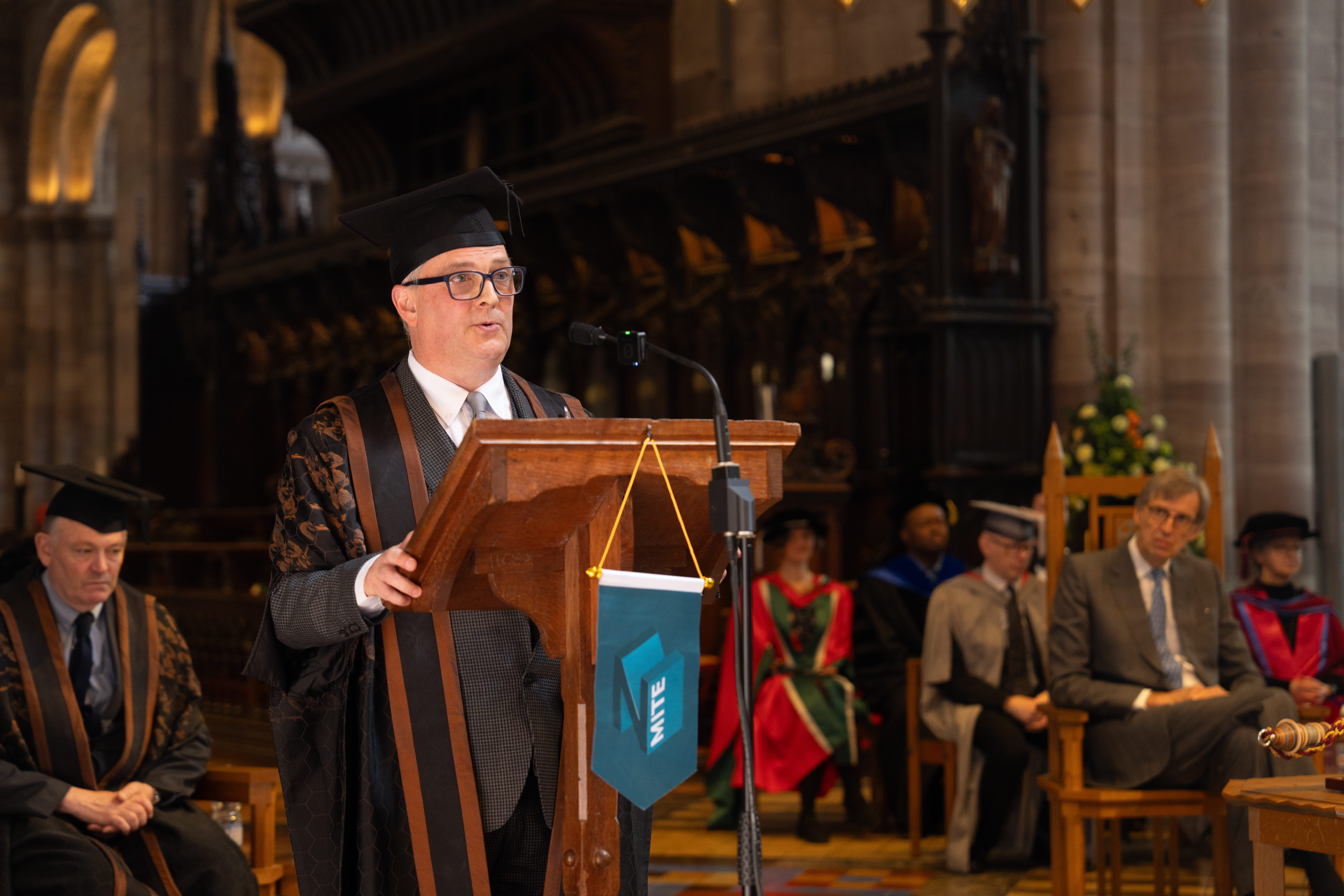
My Lord Lieutenant, Mrs Harley, distinguished guests, colleagues, partners, families, friends - and above all, our graduates.
Welcome to this celebration of our graduating cohort of 2026.
And to our graduates: you are NMITE’s second cohort. Sensible choice. Let someone else go first, find out where the wheels come off - and then do it all better.
This is a graduation address address, so we will look to the future in a moment. But first, a few thank yous.
Thank You
Thank you to my colleagues - the people who teach, challenge, support and guide our students every day. Just two weeks ago, the prestigious Institution of Engineering and Technology accredited the degrees you are being awarded today. A significant milestone - and one achieved by this exceptional team of colleagues..
Thank you also to our partners, supporters, and the wider Herefordshire community, who have welcomed us and share the belief that world-class educational opportunity belongs here.
Thank you to our Board of Trustees, who have supported the institution with calm judgement and just enough challenge to keep me properly on my toes.
A special note of thanks from me to our Chair. Devoted, tireless, ambitious, hugely supportive - and only occasionally exasperating. Our division of labour is now well established: he challenges me to aim for what feels beyond reach, I explain reality, and then we agree that reality will have to adjust. Usually, we end up with something far better than either of us started with.
It is also a pleasure to welcome back former colleagues, and current friends of NMITE who helped build the institution. Patricia Xavier, Ian Chapman - thank you. Your contribution is obvious in the graduates we celebrate today.
And because this is our second graduation ceremony, it is the first time I am able to welcome back our alumni. Finn Neate is here to address you later, and she’s brought with her Toby Street - who collected his degree on this stage last year. Yes, they met at NMITE, and, yes they are now a couple.
We are a young institution so we are constantly marking firsts at NMITE. We haven’t yet had our first NMITE wedding - but I’m simply noting the direction of travel.
And you graduates know that we must all thank the people sitting behind you today. Your success would not have happened without the support, encouragement and regular bank transfers from your families.
Most of all, thank you to you, our graduates. You chose an institution without centuries of tradition. You challenged us, improved us, and earned your success.
Meeting the Moment
This has been an extraordinary year for NMITE.
Alongside our Integrated Engineering degree, which today’s graduates have all achieved, we now have students studying on degree programmes in Mechanical Engineering, Construction Engineering - and soon, Autonomous Robotics.
We are meeting the moment.
By meeting the moment, I mean recognising what the world needs now – and choosing to act on it. For NMITE, that has meant building something different and quickly responding to new technologies and national priorities. For you, graduates, it means taking the skills you’ve learned and applying them where they matter most.
Together, we are adding to this country’s sovereign capability so that we can be more secure and less dependent on others. We are also ensuring that the talent and ambition we have always had as a country and a region, can find the opportunities it deserves
That new Autonomous Robotics programme – our drones degree – meets the moment in two key ways:
First, it addresses one of the most pressing skills needs the UK faces.
Second, it may well be one of the fastest-developed degree programmes ever seen in the UK.
How did we do that?
Well, it started with a conversation with my Chair in which he asked the two questions of me that he often asks: Why not, and why not faster?
The honest answer to that is that developing a programme like this normally involves years of careful work: industry engagement, market research, design, scrutiny, validation and a student recruitment cycle of at least two years alone.
We did all of that – just much faster than anyone else ever has and without cutting any corners.
We just refused to accept that pace and quality are incompatible.
That is how we meet the moment
Now, pace matters more than ever. The world is changing quickly. Technology is advancing rapidly. And the demand for skilled engineers - people who can design, build and make things work - is immediate and can’t wait.
And I knew we had truly “met the moment” when the press started to take an interest.
Including, somewhat alarmingly, a piece in The Times describing me as
“the university chief on the frontline of the conflict with Putin.”
Which prompted a number of helpful messages suggesting I avoid standing near upstairs windows for a while.
But the important point for you, graduates, is this:
What you have helped build - and the skills you now have - really matter.
These are real challenges. Infrastructure, national security, clean energy, economic resilience in a volatile world. And I won’t talk about the AI revolution because Prof Bob Klitgaard, brings international expertise on that topic, and will speak after me.
NMITE was created to meet a moment.
It feels like that moment is now.
Place and Pathways
Meeting the moment is not just something for institutions, it is something places must do as well.
This year alone I have had the privilege of attending the graduation ceremonies of the Art College, Herefordshire and Ludlow College, and Herefordshire Council’s Annual Apprenticeship Awards.
Each of them a celebration of achievement, full of confidence and optimism. Each of them a contribution to what we are building here together in this county.
This is an increasingly connected ecosystem of ambition and aspiration; of pathways: schools, colleges, apprenticeships and now higher education working together to help people achieve their potential. And without being forced to leave the county to find the highest level opportunities that their talent deserves.
That really matters.
Because the answer is not either/or. Not vocational or academic. Not college or university. It’s not degree or apprenticeship.
We need all of it. This county needs all of it.
And I am incredibly proud that NMITE, and this ceremony, is now part of that annual calendar of celebration and we have pushed the ceiling of achievement in the county up to degree and postgraduate level. I am also enormously grateful to see these partners with us today.
If anyone still thinks this county is “left behind” or lacking ambition, they should spend time at those events. They would see that what we are building here is not a collection of institutions, it a place working together to meet the moment.
Students meeting the moment
Now, institutions can meet the moment. Places can meet the moment, but in the end it comes down to people.
including this exceptional small cohort of students, now graduates.
Because they are meeting the moment.
What you, graduates, have done here is not easy – and your success says something about who you are.
I want, if you’ll allow me, to mention a couple of examples.
Grace
Take one of this year’s graduates.
She will shortly collect her accelerated Master’s degree in Integrated Engineering – an impressive enough achievement on its own.
As part of our second cohort, she studied while we were still building the institution around her - and she occasionally shared her views on that with me.
She will also tell you that she is no fan of maths. I can relate.
But, she wanted to be an engineer.
She won’t mind admitting there were a few tough periods for her, including occasions when she questioned whether she’d make it. We move quickly, and we ask a lot.
But she kept going.
And if all that wasn’t enough. Because alongside all of this, she also has a passion for dance. I’ve always said we welcome students from every background.
So, during the final stretch of her Master’s, while completing her demanding extended project, she spent her evenings performing in Hairspray at The Courtyard Theatre. That’s 18 hour days, one after the other, for weeks on end.
This is not the work ethic always associated with university students.
And where has that taken her?
She leaves with a Master’s degree, on the path to chartered engineering status - and a new role as an Engineering Project Manager for Airbus in their Defence and Space division.
Some people would describe those attributes she developed beyond her academic knowledge as “soft skills”.
Let me tell you, they are definitely not soft, and neither is she.
Well done Grace Merchant.
Tom
Take another of this year’s graduates.
This one is a mature student. Now in my trade, “mature” means over 21. I appreciate that definition may raise a few eyebrows in this room.
He was a terrific student - but one with a very clear itch to get on with work. Smart enough to be a thinker - but really a doer. He’d always worked before deciding to train as an engineer.
He brought that work ethic into his cohort, he set a standard and was someone others naturally looked up to.
At NMITE, we place real value on students who come to study by a different route. People taking a second chance. One reason we like them is that they tend to bring focus and motivation. They’re older and they don’t like wasting time.
Neither do we.
So after a couple of years, he stepped out of the programme to work as an engineer for BMW for year before returning to complete his studies. It’s hard to pick up where you left off with a completely different cohort. But he got through it and he collects his degree today.
He now works as a freelance engineering consultant - and I would recommend him, but I should warn you his rates are not cheap.
Congratulations Tom Reese.
And these two are not alone.
We have seen students balancing work, family, pressure, but also doubt and sometimes failure - and still turning up, every day, as the programme demands.
We’ve seen projects fail at 4.30 in the afternoon and work perfectly again at 9.00 the next morning.
And I have lost count of the number of times I’ve heard:
“It was working earlier… before you got here.”
To the Graduates
Graduates, let me finish by speaking directly to you.
You graduate into a world that is more uncertain than I have ever known it - but full of opportunity. It’s a world that needs what I have talked about today: people with the skills, judgement and courage to meet the moment. Building that sovereign capability, meeting all those big national ambitions, ultimately this now comes down to you: the people with the skills to design, build and make things work.
You have proved you can solve messy problems with no clear answers. How to work under pressure and keep your sense of humour, how to work with others and how to keep going when it seems impossible.
That should give you confidence. Not arrogance, quiet confidence.
It has been a privilege to watch you become the people you are today.
And you are not doing that alone. You are part of something bigger that is really taking shape here in Herefordshire: a growing, connected ecosystem of schools, colleges, apprenticeships and now firmly in the mix, higher education. A system that we are building to help young people move through it, with higher ceilings for their ambition and talent.
You graduate today as the products of that system. You are more connected, more practical and more aligned to what the world of work actually needs.
In a few minutes, you will walk past NMITE’s ceremonial mace as you come forward to collect your degrees. It carries a message – short, blunt and direct, not unlike our Emeritus Professor Dave Allan who coined it.
The inscription reminds you how to meet the moment with three simple words: do more faster.
You are now graduates of NMITE so we hope you now become ambassadors and advocates of NMITE. We need you to help us show that different kind of education can work, and is needed. Like us, you are now reformers.
So today you should enjoy meeting your old friends and classmates and celebrating your achievements.
Tomorrow you need take the next steps and get building.
And if something you are building doesn’t work or fails, remember what you always told me. It worked perfectly when you weren’t looking.
Class of 2026, NMITE was created to meet the moment. Now it’s your turn, Go and meet it yourselves.
Fin Neate
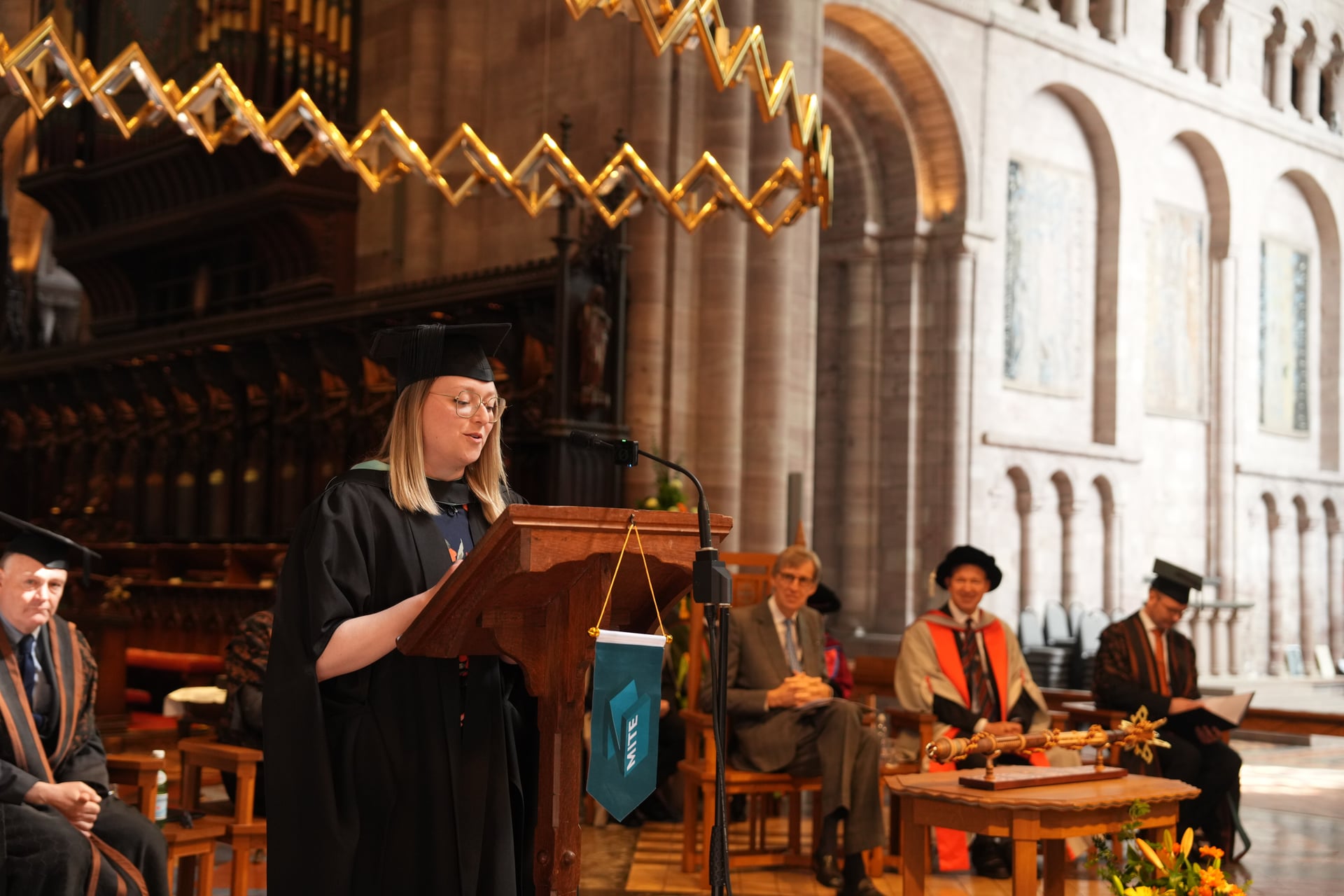
Friends, family, staff, and most importantly, our graduates – I am truly grateful and honoured to join you all today to celebrate.
To each and every one of you, sincerely, well done. As an NMITE alumni, I know only too well what it means to be an NMITE student. The journey demands an incredible amount of effort, resilience, and sheer grit, and you made it through. We are all so proud of you. And thank you to your loved ones, who patiently listened to complaints about teams and assignments, or maybe even proofread an essay or two!
Now, I'm probably not going to offer any insight you haven't already heard many times from NMITE staff and guest speakers over the years. Though, I imagine some of that advice might have been spoken when you were perhaps accidentally not listening, or maybe too busy trialling a prototype to really hear what was said. So, I will try to keep what I say concise enough that I don’t have you falling asleep at your own graduation.
First, let's talk about the foundation you've built here. It may not seem like it yet, but all the projects, both the successful and the not so successful ones, have prepared you for the real world. This, plus the early experience of working professionally with external partners and clients builds unique, confident graduates. I’ve noticed this for myself: in the fast-paced manufacturing world I now work in, my repeated experience of rapid project turnaround at NMITE really did come in handy… and quickly.
Now it’s your turn to grow beyond the studio, whether you continue into engineering or another field instead. Take the learning you developed in the safety of a university environment and apply it. Luckily for you, your experiences have given you a head start compared to many other new graduates. So, don't be afraid to give new things a go. Rely on that resilience you have cultivated and keep using your curiosity to ask questions of those with more or different experience than you.
As you step into your careers, I have a few thoughts I’d love you to carry with you as you venture through:
- Your Impact Matters. Engineers have a huge influence on the world. Even if you perceive your role as small, your decisions truly make a difference. So, choose well. Always think about the "why" behind what you are doing.
- Question Everything (Respectfully). Respect the past but always question anything anyone claims is, "just how it is". Chances are, there’s either a good reason why (already learned the hard way by someone else) – OR – a great opportunity for improvement.
- Stick to Your Morals. There is no one who can make you do something you don’t want to do, except you. Don’t rush that safety check or risk assessment. Don’t just assume "it’ll be fine." Check and check again if anything changes. Ultimately, make sure you can live with any choices you make, and that you can be confident you made the best decision you could with the information available at the time.
Navigating the professional world, funnily enough, can mirror life at NMITE. You’ll work with new people, or familiar faces in new dynamics. Deadlines shift, and project goalposts can just move entirely – and often without warning. The frustrations during your degree are not unlike the world of work. What you can control, however, is your own professionalism and which methods you choose to handle what life throws at you. And you have all had plenty of practice at that!
One more piece of advice: Make the most of connections. Reach out to people in other departments and companies. It might seem scary or unnecessary, but it is incredibly worthwhile. You’ve already done this at NMITE; just keep doing it more. Always take the opportunity to make a new contact. You never know when you’ll learn something new, find a solution, or even gain a future team member or business opportunity. And it may not be a favourite option, but speak face-to-face when you can, and occasionally, make a phone call instead of emailing. Calls and face-to-face meetings truly help connect people, reduce misunderstandings, and improve relationships by bringing the humanity back into our roles. Sometimes, we just need the reminder that we are all human.
I won’t stand here and tell you exactly what kind of engineer or person you should be. You know yourself best, and you know your goals. I only ask that wherever you end up – whether that’s food manufacturing, construction, sustainable energy, or the defence sector – follow your curiosity into new opportunities. And ensure you lead your contributions to anything with both your head and your heart.
Engineering is often about calm, calculated risks and impacts, but it is also about fierce passion for making the world a safer, fairer, and cleaner place for the generations that follow.
Choose well. Thank you.
Jesse Norman
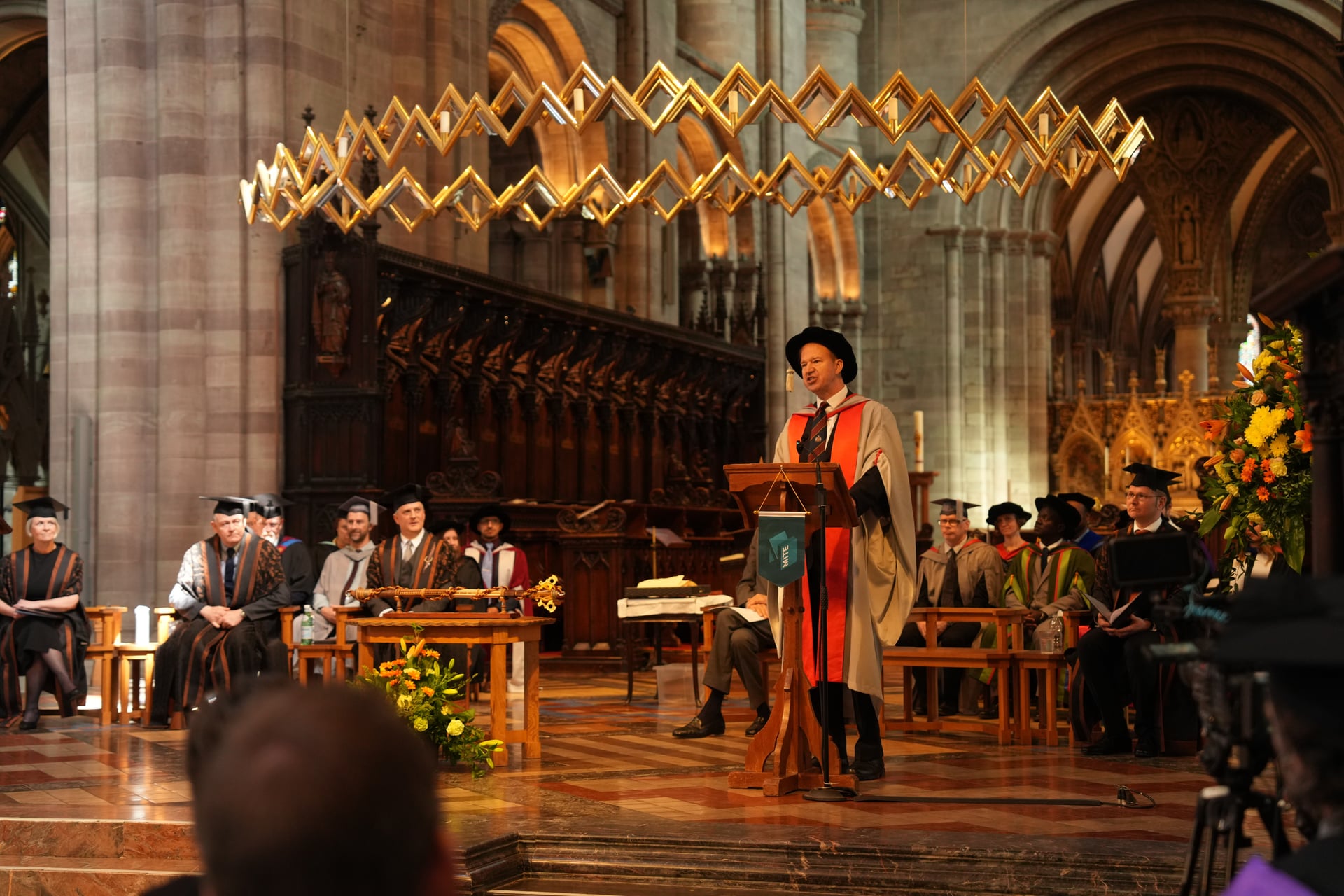
Last year I told the story of those scholars who left Oxford in 1207, more than eight hundred years ago.
They could have turned left at the crossroads and come to Hereford. Instead they turned right – and founded Cambridge University.
I spoke about Roger of Hereford and his astronomical tables. About the scholarly community that had developed here around the Cathedral, specialising in applied mathematics and cosmology, all of which was lost.
And about the thirty generations in this county who then grew up without a local university.
Let us take that story on another hundred years. To what happened when someone tried to break the Oxford-Cambridge monopoly.
--
In the year 1333, a group of Oxford scholars went north to the town of Stamford in Lincolnshire. They began to teach. Students came. A new university was being born.
The reaction was swift and brutal. Within months, Oxford had mobilised the full machinery of the state. King Edward III sent in the Sheriff of Lincolnshire, who ordered the scholars to stop teaching, and return. The experiment was crushed.
But that was not all. Oxford and Cambridge decided, in effect, to torch the ground, so that this could never happen again.
They introduced an oath. Every academic at both universities was required to swear an oath in Latin only to teach there, not to teach anywhere else, and not even to recognise as a scholar anyone who did.
And, just to be absolutely clear, they included a specific clause to the oath:
“You shall not lecture or study at Stamford, as though at a university.”
Ladies and gentlemen, that Stamford oath was sworn, not for a few months or a few years, not for a generation – but for nearly five hundred years, until 1827.
An oath designed to suppress a fledgling university that had already been destroyed, and make sure no other university was ever created that could compete with Oxford and Cambridge.
That oath outlasted the Wars of the Roses, the Reformation, the Civil War, the Enlightenment and the Industrial Revolution. It was still being sworn when Beethoven was writing his Ninth Symphony. And the year after it was abolished, University College London, the third English university, opened its doors.
This story seems scarcely credible, but every word of it is true. What was it really about?
Order, stability; yes, a little. But mainly, conformity and control.
Oxford and Cambridge had reached a deal with the Church of England and the state: they would supply the scholars, the clerks and administrators and they would suppress subversive thinkers. In return, the church and the state would protect their wealth and position.
The result was a monopoly that lasted for centuries. When Oliver Cromwell established a new college in Durham in 1653, the two universities joined forces once again to destroy it. They did the same to local efforts in Ripon, Carlisle and Shrewsbury.
I should declare an interest, as a graduate of one Oxford college and a former fellow of another. And, in many ways Oxford and Cambridge are remarkable institutions.
But for half a millennium they behaved as ruthless monopolists. Why? Because they could. Because, as Adam Smith memorably reminded us, that is what monopolists do.
And the costs of their 500 year monopoly were not borne in Oxford or Cambridge. They were borne here in Herefordshire, and places like it.
Because what was suppressed was not just new institutions. It was opportunity, talent, energy, human possibility.
Across Europe, new universities flourished, from Kraków in Poland to the city of Pisa. By the year 1790, Germany had 34 universities, Italy 26; Spain 23.
Even Scotland, with a fraction of England’s population, had five universities – five! – and they gave birth to the Scottish Enlightenment. England had just two.
Today, the Stamford oath has gone. The Oxbridge monopoly has ended. Universities have multiplied across the UK.
But history has left its impact. In a narrow, highly intellectualised view of what it is to be educated.
An elite culture disdainful of skills and largely untethered to practical experience and practical responsibility.
An instinct in government to centralise and standardise, to reject innovation and challenge; and treat new institutions not as opportunities but as risks to be managed.
--
So: what does it take to build a university that lasts?
In 1905, the University of Sheffield secured its charter. The decisive push came not from government, but from the people of that city.
Steelworkers, cutlers, miners – ordinary people – gave what they could from their wages, often penny donations. They raised £50,000, the equivalent of some £40-£50 million relative to average earnings today.
In other words, the university was not handed down from on high. It was built up from below.
That is what commitment looks like. Steady growth, deep roots, and real, enduring, material support.
NMITE stands in that tradition. A new institution, growing up from a county of doers, filled with students who chose to come here when nothing was guaranteed.
Those choices took courage. So you can see how thrilled I am that NMITE and those students, their courage and their achievement, have now been recognised with accreditation from the prestigious Institute of Engineering and Technology.
… which makes their degrees the formal chartered equivalent of any at Oxbridge or the Russell Group.
But if NMITE is to flourish over the longer term, if it is to reach its full potential, then that requires the continued commitment of us all.
Because this story is not just about a university. It is about whether a place like Herefordshire can be enabled to give its people the opportunities they deserve.
It is about whether talent can be developed where it is found, and not ignored or sent away elsewhere. Whether capital can be created outside the big cities.
Ultimately, it is about whether we as a nation have the strength of purpose, the mission, not to stagnate but to build institutions that expand our human capability and possibility across this country, now and for the future.
All of you, everyone who believes in that mission, has a part to play.
Through your partnership, your advocacy, your support. Through the simple but overwhelmingly powerful act of saying: this matters, and I will back it.
We have made a start, but the only true way to honour those generations who never had the opportunity is to make sure that this university endures, and thrives and grows.
--
Let me say this:
To our graduates: you too are pioneers. You chose a university still in formation, still proving itself. You placed a bet on us.
We hope and believe that we have begun to repay that trust. The world needs people who can build as well as think. Go and be both.
To all our families and friends: thank you for your faith and your courage in supporting these students, and their choices.
To James our brilliant Chief Executive, our wonderful staff, trustees and partners: you are building a culture of seriousness, of purpose, of capability. Thank you.
To our supporters and donors: you have never forgotten the motto of Edwin Land, one of America’s greatest inventors, when he said:
Don’t undertake a project unless it is manifestly important – and nearly impossible.
Without you, without you all, none of this would exist. We will always be grateful.
And to everyone here, I say:
Remember Stamford, remember what happens when narrow interests prevail over entrepreneurship and vision.
And remember that for five centuries, that Stamford oath was sworn to prevent exactly what we are doing now.
So: let us all say together: we are not going to let that happen here. Not in this place. Not in this time. Not on our watch.
We are not going to let that happen here. Not in this place. Not in this time. Not on our watch.


