Ask AI what N or M or NM suggest, it will respond with Négociant-Manipulant, nanometre, nautical mile, never mind or not/nothing much.
NMITE adds another: New Model. A New Model expressly created to transform engineering and technical higher education, resulting in ethical, globally aware professionals thus transforming graduate employability and as a consequence enabling sustainable economic development in the Marches.
In inviting students to NMITE “To be an Engineer or To be a Construction Professional” and by placing innovation at the heart of technology and engineering education the New Model liberated many of its faculty from the traditional strictures and narrow confines of science and mathematics. It wove other subjects essential to innovation (economics, management, ethnology, rhetoric, marketing, sociology, ethics, etc) into an eclectic mix of novel, yet proven, learning methods gleaned from schools, universities and educational innovators worldwide to produce a globally unique learning and teaching approach. This new model and signature educational approach is the NMITE Way.
This month NMITE’s sixth cohort of over 100 students will enroll on an NMITE Way informed programme boosting NMITE’s enrollment to ca. 250 students. In parallel the team that teaches and supports those students is growing. To ensure the quality, excellence, consistency and distinctiveness of the New Model, NMITE must ensure that its academics and those that support students all have the requisite knowledge, skills, and attitudes needed to facilitate that learning journey. Professor Sarah Hitt, Programme Lead BSc Construction Management and seven other Academic Lead Curriculum Partners have, over the last nine months, led a multi-disciplinary group to co-create the NMITE Way programme.
“Our co-creation approach epitomises the NMITE Way,” explained Sarah. “It was essential to not only get buy-in across the organisation but also to create a sense of shared ownership and purpose. All the while embracing a humble and curious attitude with an overarching commitment to excellence.
Embedding the NMITE Way
“So, starting this month a yearlong, continuously improving and innovating, rolling programme that ensures that all, teaching staff and eventually all staff at NMITE, not only experience elements of a student’s learning journey but are also deeply imbued with the fundamental values and practical skills that make the NMITE Way unique and a global leader.
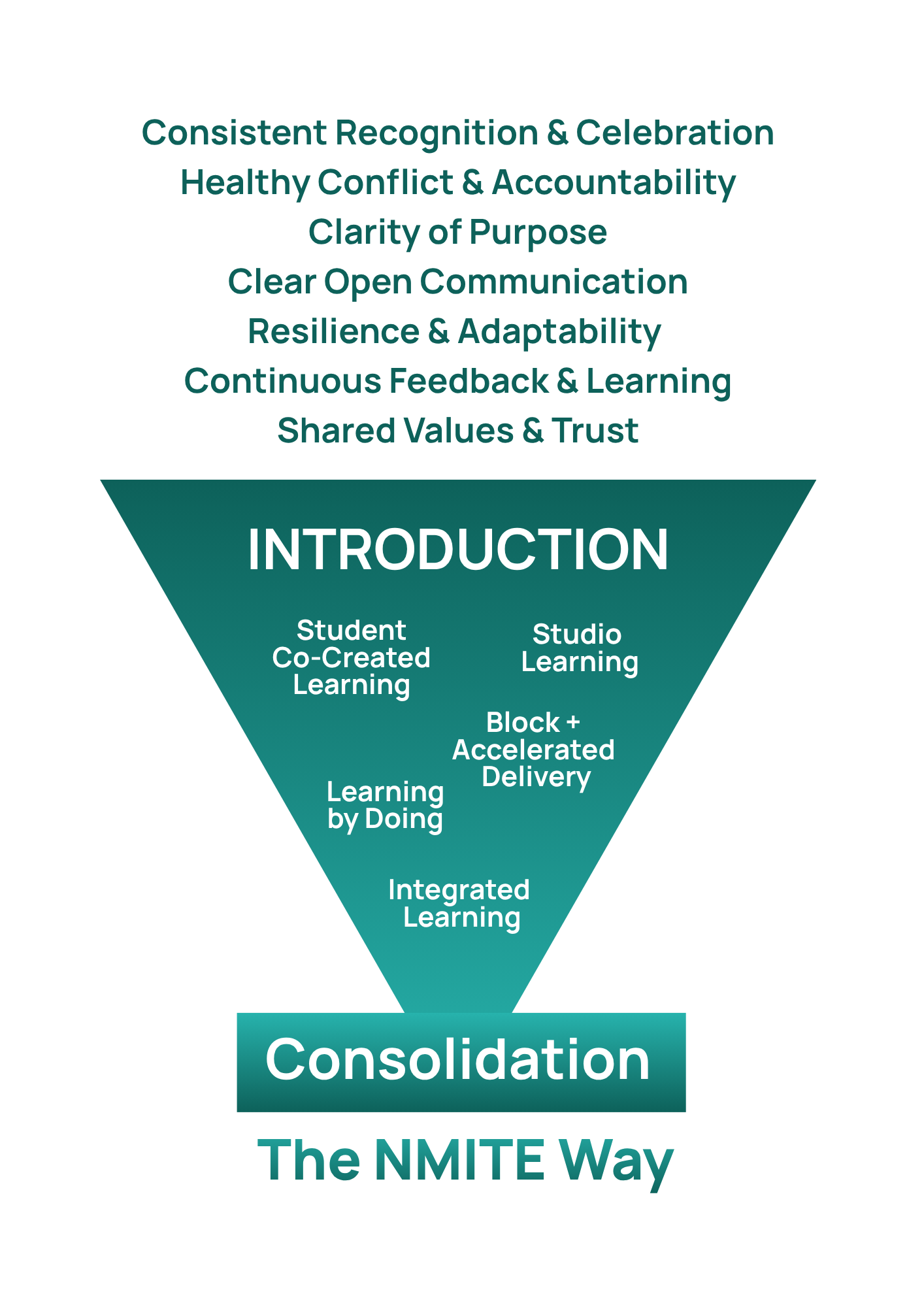
Details of the five core elements are explained below by each module leader
“Aligned to the academic year and split into seven modules, of which the first and last are mandatory, faculty will be expected to take each module but in any order. In subsequent years colleagues can hone or update their capabilities and also share their learning with colleagues. It will become initially a sort of academic MoT. In time I believe it should be accepted as CPD and ultimately recognized as a teaching qualification,” concluded Sarah.
The introductory module will be led by Sarah Hitt and Associate Professor Laura Leslie. “It explores how staff and the NMITE Way Elements come together,” explained Laura. “Combining theoretical knowledge, practical observation, and self-reflection, the module encourages participants to create a personal plan for self-development, which aligns with the New Model way.”
Emeritus Professor, Dave Allan one of the early developers of the NMITE Way, will lead the studio learning element. “At NMITE a Studio is an open, flexible room designed for hands-on making, teamwork, and active problem-solving rather than the passive listening of a lecture theatre. The primary aim of the module,” he stressed, ”Is to provide an opportunity for educators to understand the opportunities and advantages made available by the NMITE approach. They will discuss the principles behind the NMITE Model, will have the opportunity to experiment with the creation of novel learning activities which drive positive interdependent learning and will explore the ways to maximise the benefits of studio-based learning.”
Integrated learning
Head of Academic Skills, Associate Professor Dr Sarah Peers said “ In my role at ASK, I seek to ensure that our teaching colleagues have the resources and support to integrate soft/transferable skills into every aspect of a student’s journey in becoming an engineer. This is a key part of integrated learning, but in addition, the NMITE Way is also about integration across disciplines and sectors. In this module we show and experience how critical thinking, problem solving, interdisciplinarity, mathematics and science, humanities and the liberal arts, communication, team working, analytical reasoning, data interpretation, communication, ethics, creativity, imagination and a worldview can and should be woven into our modules and to grow a student’s capabilities.”
Learning-by-Doing,
Learning-by-Doing or Challenge Based Learning is based on the Confucian precept: I hear and I forget. I see and I remember. I do and I understand. “During a student’s time at NMITE they will tackle 15 or more Challenges (set by business partners).” explained module leader Associate Professor Peter Metcalfe: “Apart from the technical learning that these challenges provide, they also start to build students’ problem solving mindset. They begin to experience team working – which many struggle with; they learn how to question a brief and explain their solutions; they learn how to make their ideas work and realise that failure is an opportunity to find a better answer.
“In this module, staff develop their understanding of and ability to produce the key components, such as challenge statements and client briefs, required to plan and deliver Challenge-based Learning, developing an understanding of how different partner and interaction types drive delivery. Matching a business or community partner’s needs with the learning academic outcomes required is demanding but produces outstanding results. Real authentic problems really do motivate students; they experience firsthand what it is to be an engineer or technical professional.”
Student Co-created learning
“This module,” said Associate Professor Joseph Oyekale, “Allows faculty members to explore how students become genuine partners in learning by sharing responsibility for inquiry, decision-making, and reflection. Grounded in NMITE's learning approach, the module develops practical strategies for designing learning experiences where students actively shape the learning journey, fostering ownership, engagement, and lifelong learning capabilities.”
Block teaching and accelerated delivery
“At NMITE we believe that you can only be an engineer by engineering or a construction manager by managing construction. Doing is everything,” emphasised Associate Professor, Steve Bertasso. “The traditional concurrent module/lecture structure causes fragmentation in learning. Allowing students to be immersed in and concentrate on one subject at a time boosts student engagement and fosters deeper understanding. We set out to show colleagues the power of block and accelerated delivery and how it opens new avenues for impactful teaching.”
Consolidation and Innovation
The NMITE Way programme is wrapped up by Professor Hitt and Associate Professor, Dr Mo Sayed.
“We will step back and reflect on the whole programme,” concluded Mo. “It will be our opportunity to co-create the future of the programme by sharing feedback, challenging assumptions, and shaping future iterations. Like all innovative activities we will remind ourselves that the journey doesn't end here; indeed a New Model requires that we are always modelling newness.”